Pillar Page 4: Product & UX Design – The SaaS User Activation & Retention Framework
1. Executive Overview: Engineering Product-Led Customer Growth
In the highly competitive software landscapes of Product & UX Design, user experience has moved far beyond aesthetic styling. Today, product design functions as a core financial engine for the modern Software-as-a-Service (SaaS) enterprise. When a software platform fails to guide a user to value quickly, it faces immediate customer churn. No amount of aggressive performance marketing or enterprise sales outreach can compensate for a broken, high-friction product interface. Sifting your focus toward product-led growth (PLG) architecture is the only sustainable way to build long-term enterprise asset value.
This operational product design manual serves as the central UX authority for the Cloudsticker ecosystem. It provides product managers, UI/UX designers, and growth engineers with the structural frameworks required to optimize user onboarding paths, maximize feature engagement, and institutionalize product retention systems. By focusing heavily on data-driven behavior mapping, self-serve user activation, and friction elimination, this documentation outlines how to transform casual software signups into deeply retained power users.
2. Core Operational Sub-Components of SaaS Product Architecture
To construct a software product that retains customers natively, product squads must master three distinct experiential tracks. These pillars form the tactical foundation of user retention.
Optimizing the First-Time User Experience (FTUX)
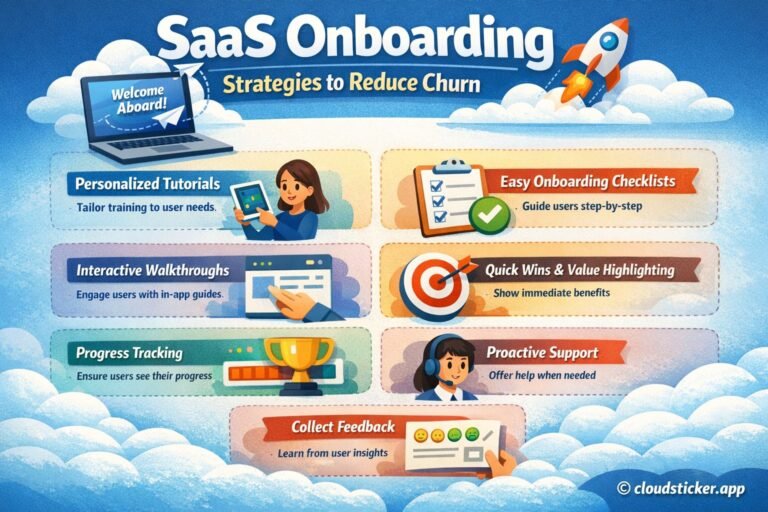
The first-time user experience (FTUX) is the most critical sequence within the customer lifecycle. It dictates whether a new signup successfully reaches their initial “Aha! moment”—the exact instance they experience the core value proposition of your application. An enterprise-grade FTUX discards long, dry instructional wizards in favor of interactive sandboxes, empty-state templates, and contextual, action-driven tooltips. By reducing the Time-to-Value (TTV) to minutes, you drastically minimize early-stage workspace abandonment.
Self-Serve User Onboarding and Lifecycle Email Sequences
User onboarding does not end when a user finishes an interactive product tour; it is a multi-layered process that spans across the product interface and external touchpoints. A professional onboarding framework synchronizes in-app modals with lifecycle email automation tracks. If a user drops off during a crucial setup configuration (such as failing to invite teammates or connect an API gateway), background triggers must immediately deploy targeted, educational email sequences. These messages must deliver context-specific solutions that draw the user back into the active workspace.
Feature Adoption and Engagement Architecture
Sustaining long-term Customer Lifetime Value (LTV) requires driving continuous deep feature adoption. Users who only interact with a single superficial feature are highly susceptible to competitor poaching. Product architecture must incorporate smart feature discovery loops—such as inline banners, subtle notification badges for advanced tools, and contextual feature upgrade gates. By systematically exposing users to advanced secondary utilities that align with their active workflows, you naturally embed your product into their daily standard operating procedures.
3. Metric-Driven UX Design: Designing for True Behavioral Activation
To escape subjective design debates, modern product leads use empirical behavioral analytics. Product choices should be dictated by how real users move through your interface, shifting focus away from vanity feature counts toward core usage depth.
Tracking Downstream User Activation Metrics
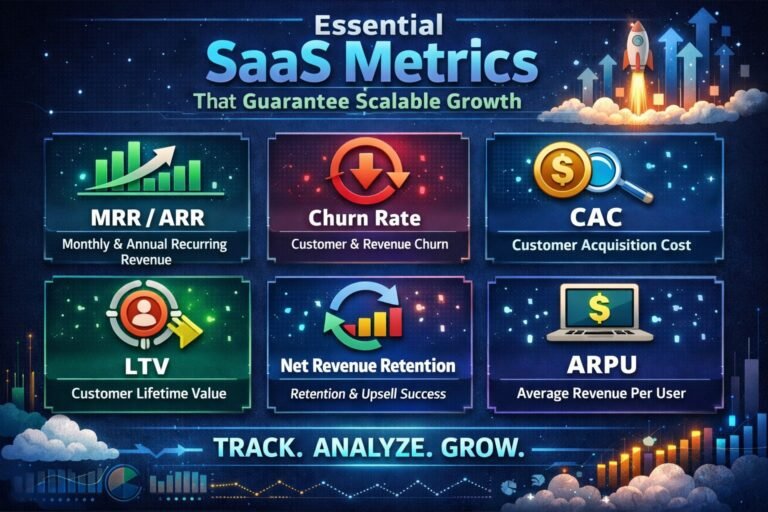
A signup is a marketing metric; an activated account is a product metric. Product teams must explicitly define what constitutes “activation” within their unique software framework. For a project management tool, activation might mean creating a board and inviting three teammates within 48 hours. For an email service provider, it could mean sending the first 100 broadcast messages. UX layouts must be relentlessly optimized to push users toward these precise activation triggers, using clear UI hierarchies to highlight the required actions.
Cohort Analysis and Churn Isolation
Cohort analysis allows product teams to group users based on their signup date and track their operational retention decay over time. By combining cohort reports with in-app event tracking (such as tool like Mixpanel or Amplitude), data teams can pinpoint exactly where the user journey breaks. If data reveals that 40% of a cohort drops off on day seven, engineers can audit that specific drop-off screen to remove hidden friction, fix broken onboarding states, or adjust the email nurture pacing.
4. Step-by-Step Product-Led Execution Framework
Deploying an institutional-grade product experience requires following a strict, chronological execution path designed to isolate variables and maximize engagement.
Phase 1: Contextual Profiling and Friction Audits
Before writing a single line of interface code or designing new feature screens, product teams must analyze user intent.
- Frictionless Welcome Surveys: Deploy single-question contextual signup modals to identify the user’s specific role (e.g., Engineer, Marketer, Executive) and immediate goal.
- Tailored Workspace Provisioning: Use the profile data to dynamically configure the user’s default dashboard, populating it with role-specific templates so they aren’t forced to start with a blank canvas.
- Performance Speed Optimization: Run core asset audits to ensure dashboard load times stay under 1.5 seconds, as slow loading states are a primary driver of instant bounce rates.
Phase 2: Deploying Progressive Disclosure Loops
Once the baseline workspace is established, teams layer on progressive disclosure mechanisms to prevent cognitive overload.
- Action-Triggered Guideposts: Hide advanced, complex configuration menus behind intuitive dropdown menus, revealing them only when the user completes introductory milestones.
- Inline Empty-State Triggers: Replace blank dashboards with interactive setup placeholders that instruct the user exactly how to input data to unlock that specific feature module.
Phase 3: Feedback Loops and Continuous Optimization
The final stage of the framework integrates continuous qualitative and quantitative feedback into the release sprint cycle.
- Micro-NPS and In-App Surveys: Trigger targeted, single-click feedback prompts directly after a user completes a major milestone to measure customer sentiment accurately.
- Automated Feature Prioritization: Route user feature requests into a structured prioritization matrix (such as the RICE framework) to balance engineering bandwidth against verified customer demand.
5. Product UX Pitfalls, Retention Cracks, and Risk Mitigation
The most common and destructive failure in modern software design is Feature Bloat. When product teams continuously ship new features to appease outlier requests without optimizing the core user journey, the application interface becomes cluttered, confusing, and heavy. This cognitive friction degrades the primary user experience, accelerating user churn among the core customer base.
To insulate your application from product decay, product managers must enforce strict operational guardrails:
- Relentless Simplification: Routinely run feature audits to identify and deprecate low-usage feature modules that clutter the navigation menu.
- A/B Vetted Releases: Never roll out major structural layout alterations to 100% of your user base simultaneously; run controlled canary deployments or split-tests to verify engagement retention metrics first.
- Graceful Failure States: Design helpful, clear error states and contextual support widgets so that when an integration or upload fails, the user is given an instant path to resolution rather than a dead-end screen.
6. Active Product Blueprints & UX Resource Index
The physical engineering of a high-retention software product requires accessing field-tested user onboarding checklists, wireframe templates, and feature rollout strategies.
Review our latest published documentation below to audit your current user activation metrics, optimize your application onboarding sequences, and deploy world-class product retention blueprints inside your operational sandbox.
-
Activation-Optimized SaaS User Experiences That Convert Fast
Unlock seamless user experiences for SaaS that drive rapid conversions.
-
Rapid SaaS Adoption Tactics That Drive User Growth
Discover effective strategies to accelerate SaaS adoption and boost user growth rapidly. Unlock your organization’s potential today.
-
Engagement-Optimized SaaS Product Strategies That Retain
Unlocking engagement strategies is key to retaining SaaS users.
-
Maximizing SaaS Product Adoption: A Playbook for Engagement
Boost user engagement with proven SaaS adoption strategies.
-
Effective SaaS Onboarding Email Sequences to Boost Activation
Boost activation with effective SaaS onboarding email sequences.
-
Essential SaaS Activation Metrics for Tracking Growth Effectively
Track key SaaS activation metrics to drive effective growth.