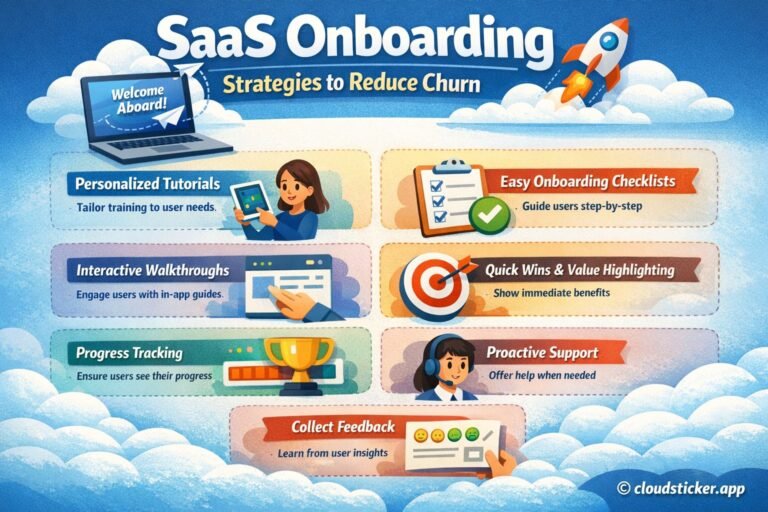
Tag: onboarding

  • Game-Changing SaaS Onboarding Strategies to Reduce Churn and Improve User Retention

    Game-Changing SaaS Onboarding Strategies to Reduce Churn and Improve User Retention

    In Software as a Service (SaaS), the importance of effective SaaS Onboarding Strategies to Reduce Churn cannot be overstated. A seamless onboarding experience is crucial not just for user satisfaction, but also for reducing churn rates, which can significantly affect a company’s bottom line. The initial interaction that new users have with your software sets the tone for their long-term relationship with your product. Hence, organizations must adopt game-changing onboarding methods that are designed to engage users right from the start and keep them coming back for more.

    Understanding the Importance of Effective SaaS Onboarding Strategies to Reduce Churn

    SaaS onboarding is often the first and most critical step in the customer journey. The onboarding process introduces users to the software, helping them understand its features and benefits. A well-executed onboarding experience can directly influence user retention, satisfaction, and overall lifetime value. Studies show that 86% of users are likely to stay with a product if they have a positive onboarding experience. Conversely, a poor onboarding process can lead to immediate frustration and abandonment, driving users to seek alternatives.

    Moreover, effective onboarding can differentiate your SaaS product in a crowded market. Companies that invest in user onboarding see improved customer engagement and loyalty. Users who are well-informed about the product’s features are less likely to churn, as they perceive the value derived from the software. This is particularly important for large organizations that require a comprehensive understanding of a tool’s capabilities to maximize its potential.

    Finally, onboarding is not just a one-time event; it should be viewed as an ongoing relationship-building exercise. Continuous engagement through various strategies such as personalized follow-ups, educational resources, and community-building can transform a one-off interaction into a sustainable partnership. This long-term approach can vastly reduce churn rates, leading to enhanced customer lifetime value and better overall business performance.

    Key Metrics to Measure SaaS Onboarding Strategies to Reduce Churn

    To gauge the effectiveness of your onboarding process, it’s essential to track specific metrics. Key performance indicators (KPIs) such as Time to First Value (TTFV), product adoption rate, and user engagement scores provide valuable insights into how well users are acclimating to your software. TTFV measures the duration it takes for a new user to recognize the value of your product. The shorter this time frame, the more likely users are to stick around.

    Another critical metric is the churn rate itself. Understanding the percentage of users who discontinue using your service within a specific period can help identify gaps in your onboarding process. A high churn rate typically signifies issues with user experience or value perception. Companies should also analyze customer feedback to pinpoint the exact reasons behind churn. This will not only highlight existing shortcomings but also pave the way for improvements in the onboarding process.

    Lastly, cohort analysis allows organizations to segment users based on their onboarding experiences and monitor their behavior over time. By understanding how different groups of users interact with your product post-onboarding, you can uncover patterns that influence churn and engagement. These insights will enable you to refine your onboarding strategies, ensuring that you are effectively meeting the needs of your diverse user base.

    Personalization: A Game-Changer in User Engagement

    In an era where users crave tailored experiences, personalization in onboarding can make a significant difference. Addressing individual needs and preferences increases user engagement and satisfaction. When users feel that a product is designed specifically for them, they are more likely to invest time in learning its features. Customizing onboarding journeys whether through targeted messaging, feature recommendations, or specific training sessions can create a sense of attachment and commitment to your software.

    Additionally, leveraging user data to personalize onboarding ensures that you are providing relevant information at the right time. For example, if a user shows interest in a specific feature, you can highlight that during onboarding, guiding them towards achieving their goals. This data-driven approach can significantly enhance user experience, leading to higher retention rates. When users see immediate value tailored to their needs, they are less likely to explore competitors.

    Finally, personalization doesn’t end with the initial onboarding process; it should be an ongoing effort. Use feedback to continuously refine your onboarding approach and adapt to changing user needs. Regular touchpoints such as personalized emails, updates on new features, and invitations to webinars help reinforce the relationship and keep users engaged over the long term.

    Interactive Tutorials That Keep Users Coming Back

    Interactive tutorials are another effective method for enhancing the onboarding experience. Traditional manuals and static guides often fail to capture user attention and can leave new users feeling overwhelmed. On the other hand, interactive tutorials encourage active participation, allowing users to learn by doing. When users engage with the software hands-on, they are more likely to remember features and workflows, fostering a deeper understanding of the product.

    An effective interactive tutorial should be intuitive and user-friendly. Incorporating elements such as tooltips, guided walkthroughs, and pop-up explanations can help users navigate through the software seamlessly. These interactive elements empower users to explore the product at their own pace while ensuring they grasp key functionalities. Additionally, gamifying the tutorial experience can increase motivation and engagement. For instance, offering rewards for completing certain tasks can make learning feel less like a chore and more like an achievement.

    Moreover, consider implementing a feedback mechanism within the tutorial. By allowing users to share their thoughts or report difficulties, you can gather invaluable insights to enhance the onboarding experience further. Regularly updating tutorials based on user feedback ensures that the content remains relevant and useful, effectively reducing the chances of churn.

    Building Community: Leveraging User Support Networks

    A strong community can be a powerful asset in reducing churn and enhancing the onboarding experience. When users feel part of a supportive network, they are more likely to engage with the product and seek help when needed. Creating forums, user groups, or social media communities allows users to connect, share tips, and troubleshoot issues together. This sense of belonging can alleviate the feeling of isolation that often accompanies new software adoption.

    Community engagement fosters a culture of collaboration and learning, which can be particularly beneficial for large organizations. Employees can share best practices, facilitating knowledge transfer and ultimately speeding up the adoption process. Additionally, leveraging community insights can guide product development. User-generated content such as FAQs, tutorials, and case studies can enrich the onboarding experience and provide new users with valuable resources.

    Furthermore, consider organizing online or in-person events such as webinars, Q&A sessions, or user conferences. These events not only provide opportunities for users to learn more about the software but also strengthen community ties. By showcasing success stories and encouraging user participation, you can create ambassadors who advocate for your product, further reducing churn and enhancing user loyalty.

    Automation Tools to Streamline Your Onboarding Process

    Incorporating automation tools can drastically improve the onboarding process, allowing organizations to scale their efforts without sacrificing quality. Automated onboarding emails, reminders, and check-ins can ensure users receive timely information without overwhelming staff resources. For instance, setting up a welcome email series that introduces key features can provide new users with a structured approach to learning the software.

    Moreover, automation can facilitate personalized experiences at scale. By integrating user data into your onboarding platform, you can tailor communications based on user behavior and preferences. This level of personalization, combined with automation, can significantly enhance user engagement, making them feel valued and understood from their first interaction.

    Finally, automation can help track onboarding completion rates and user engagement metrics in real time. This enables organizations to identify at-risk users who may need additional support or resources. Proactively reaching out to these users can prevent churn and reinforce the importance of the onboarding journey. Implementing automation tools will not only streamline your process but also create a more engaging experience for users.

    Gathering User Feedback for Continuous Improvement

    User feedback is essential for refining your onboarding strategies. Regularly soliciting input through surveys, interviews, or feedback forms can provide valuable insights into user experiences. Understanding what aspects of the onboarding process users appreciate and what challenges they face can help you make data-driven improvements. For instance, if multiple users cite confusion over a specific feature, it may be time to enhance the associated tutorial or provide additional resources.

    Moreover, creating an open channel for feedback encourages a culture of communication and trust. When users feel their opinions matter, they are more likely to engage with your product actively. Using tools like Net Promoter Score (NPS) can help gauge overall user satisfaction and loyalty. High NPS scores are indicative of a successful onboarding experience, while low scores may point towards areas needing immediate attention.

    Finally, integrate feedback into your product development cycle. Collaborating with your product team to address user concerns will not only improve the onboarding experience but also enhance the product itself. Continuous improvement based on user feedback ensures that your onboarding process evolves with user needs, ultimately reducing churn and fostering long-term relationships.

    Analyzing Data to Refine SaaS Onboarding Strategies to Reduce Churn

    Understanding the factors contributing to churn is crucial for refining your onboarding strategies. By analyzing churn data, organizations can identify common trends and issues that might be leading users to disengage. For instance, if a specific demographic or user segment displays higher churn rates, it may signal a need for tailored onboarding approaches for that group. This analysis can guide targeted interventions that directly address the issues causing users to leave.

    Additionally, consider conducting exit interviews with churned users to gain qualitative insights. These conversations can uncover underlying issues that quantitative data may not reveal. For example, users may express dissatisfaction with certain features or mention that the onboarding process was too complicated. By employing a combination of qualitative and quantitative analysis, organizations can create a more comprehensive understanding of churn drivers.

    Finally, use the insights gained from churn analysis to develop targeted onboarding initiatives. For instance, if data shows that users tend to drop off after specific feature introductions, consider revising how those features are presented during onboarding. By continually refining your onboarding strategies based on churn data, you can create a more compelling experience that resonates with users and minimizes churn.

    Frequently Asked Questions

    What is SaaS onboarding and why is it critical for reducing churn?

    SaaS onboarding is the structured process of guiding new users from initial sign-up to meaningful product usage. It ensures users understand how to use the platform and achieve value quickly.

    In enterprise environments, onboarding directly influences churn because it shapes first impressions and determines whether users see immediate value. If users fail to understand the product early, they are far more likely to disengage and abandon it.

    Effective onboarding reduces friction, accelerates value realization, and builds long-term engagement, all of which are essential for minimizing churn.

    How does onboarding impact customer retention in SaaS?

    Onboarding is one of the strongest predictors of customer retention. When users quickly understand how a product solves their problems, they are more likely to continue using it.

    A well-designed onboarding experience increases confidence, reduces frustration, and reinforces perceived value. In contrast, poor onboarding leads to confusion, underutilization, and ultimately churn.

    Organizations that invest in onboarding typically see improvements in retention rates, customer satisfaction, and lifetime value.

    What are the most important SaaS onboarding metrics to track?

    Key metrics include Time to First Value (TTFV), activation rate, feature adoption rate, and churn rate. TTFV measures how quickly users experience meaningful value after signing up.

    Activation rate tracks how many users complete key onboarding milestones. Feature adoption rate indicates whether users are engaging with core functionalities.

    Churn rate remains the ultimate measure of onboarding success. In enterprise SaaS, these metrics are often analyzed together to provide a comprehensive view of onboarding effectiveness.

    What is Time to First Value and why does it matter?

    Time to First Value refers to the time it takes for a new user to realize the core benefit of a product. It is a critical metric because it directly impacts user perception and engagement.

    The faster users experience value, the more likely they are to continue using the product. Long or complex onboarding processes that delay value realization increase the risk of churn.

    Reducing TTFV should be a priority for any SaaS organization aiming to improve retention.

    How can personalization improve SaaS onboarding?

    Personalization enhances onboarding by tailoring the experience to individual user needs, roles, and goals. Instead of a generic approach, users receive relevant guidance and feature recommendations.

    In enterprise SaaS, personalization can be based on industry, job function, or usage patterns. This ensures that users focus on features that are most relevant to their workflows.

    Personalized onboarding reduces cognitive overload, increases engagement, and accelerates adoption, all of which contribute to lower churn rates.

    What are the most effective onboarding strategies for SaaS products?

    Effective strategies include interactive walkthroughs, contextual tooltips, onboarding checklists, and guided product tours. These approaches help users learn by doing rather than relying solely on documentation.

    Additional strategies include onboarding emails, webinars, and in-app messaging to reinforce learning. Providing clear use cases and real-world examples also helps users understand the value of the product.

    In enterprise environments, combining self-service onboarding with human support, such as customer success teams, often delivers the best results.

    How important is user experience in onboarding?

    User experience is fundamental to onboarding success. A complex or unintuitive interface can undermine even the most well-designed onboarding process.

    Clear navigation, intuitive design, and minimal friction are essential for helping users progress smoothly. Poor user experience leads to frustration, delays in value realization, and increased churn risk.

    Organizations must continuously refine their user experience to ensure onboarding remains efficient and effective.

    Can onboarding alone eliminate churn?

    Onboarding plays a significant role in reducing churn, but it cannot eliminate it entirely. Churn is influenced by multiple factors, including product value, pricing, competition, and customer support.

    However, onboarding is one of the most controllable factors. A strong onboarding experience can significantly reduce early-stage churn and set the foundation for long-term retention.

    To achieve sustained results, onboarding must be integrated with broader customer success and engagement strategies.

    How can companies identify onboarding gaps?

    Onboarding gaps can be identified through data analysis, user feedback, and behavioral tracking. Metrics such as drop-off rates, incomplete onboarding steps, and low activation rates highlight problem areas.

    User feedback through surveys, interviews, and support interactions provides qualitative insights into pain points. Session recordings and analytics tools can also reveal where users struggle.

    By combining these insights, organizations can pinpoint weaknesses and continuously improve the onboarding experience.

    What role does customer support play in onboarding?

    Customer support is a critical component of onboarding, especially in enterprise SaaS environments. Support teams help users overcome challenges and ensure a smooth transition into the product.

    Proactive support, such as onboarding calls and check-ins, can significantly enhance user confidence and engagement. Reactive support ensures that issues are resolved quickly, preventing frustration.

    Strong collaboration between product, onboarding, and support teams is essential for delivering a seamless experience.

    How does onboarding differ for enterprise SaaS compared to small business SaaS?

    Enterprise SaaS onboarding is typically more complex due to larger user bases, multiple stakeholders, and integration requirements. It often involves customized onboarding plans, training sessions, and dedicated support.

    Small business SaaS onboarding is usually more standardized and self-service, focusing on simplicity and speed.

    Enterprise onboarding requires a more strategic approach, emphasizing change management, stakeholder alignment, and long-term adoption.

    What is the role of automation in SaaS onboarding?

    Automation enables scalable and consistent onboarding experiences. Automated workflows, emails, and in-app guidance ensure that users receive timely and relevant information.

    Automation also reduces manual effort and allows teams to focus on high-value interactions. For example, automated onboarding sequences can guide users through key steps without requiring constant human intervention.

    When combined with personalization, automation can significantly enhance onboarding efficiency and effectiveness.

    How can organizations continuously improve onboarding performance?

    Continuous improvement requires ongoing monitoring, testing, and iteration. Organizations should regularly review onboarding metrics and user feedback to identify areas for enhancement.

    A/B testing different onboarding flows can help determine what works best. Updating content, refining user journeys, and incorporating new features into onboarding are also important.

    In enterprise environments, aligning onboarding improvements with business objectives ensures that efforts deliver measurable value.

    What are common mistakes in SaaS onboarding?

    Common mistakes include overwhelming users with too much information, failing to demonstrate value quickly, and using generic onboarding experiences.

    Another issue is neglecting post-onboarding engagement, which can lead to declining usage over time. Poor communication and lack of support also contribute to ineffective onboarding.

    Avoiding these mistakes requires a user-centric approach that prioritizes clarity, relevance, and continuous engagement.

    Why is SaaS onboarding a strategic priority for business growth?

    SaaS onboarding is directly linked to key business outcomes such as retention, revenue growth, and customer lifetime value. It is not just a product function but a strategic capability.

    Organizations that excel in onboarding differentiate themselves in competitive markets by delivering superior user experiences. This leads to higher engagement, stronger customer relationships, and sustainable growth.

    Ultimately, effective onboarding transforms new users into long-term customers, making it a critical driver of SaaS success.

    Conclusion – SaaS Onboarding Strategies to Reduce Churn

    Effective SaaS onboarding is an ongoing journey rather than a one-time event. By adopting game-changing methods such as personalization, interactive tutorials, and leveraging community support, organizations can create a seamless onboarding experience that keeps users engaged. Additionally, employing automation tools and continuously gathering user feedback will provide valuable insights for improvement. Ultimately, analyzing churn data allows you to refine your strategies and ensure that users recognize the value of your product, leading to increased retention and customer loyalty.

    Hashtags: #SaaS #Onboarding #UserEngagement #ChurnReduction #CustomerFeedback

    Call-to-Action: For more insights on improving SaaS user onboarding, visit Eleken for expert resources and case studies.

    Discover SaaS Feature Adoption Strategies

  • Retention-Focused SaaS Funnel Systems That Reduce Churn

    Retention-Focused SaaS Funnel Systems That Reduce Churn

    In the competitive landscape of Software as a Service (SaaS), retaining customers has become paramount. While gaining new customers is essential, the cost of customer acquisition often overshadows the long-term value that loyal users bring. Retention-focused SaaS funnel systems play a significant role in reducing churn rates, ensuring that customers remain engaged and satisfied with the service. This article will explore effective strategies and systems that enterprises can implement to bolster user retention and enhance overall satisfaction.

    Understanding the Importance of Retention in SaaS Models

    Retention is not merely a metric; it represents the foundation of sustainable growth in SaaS business models. High churn rates can devastate revenues and undermine the potential for expansion. When customers leave, they take with them not only their recurring revenue but also their valuable feedback and insights that could improve the product. For large organizations, ensuring customer satisfaction and loyalty becomes a strategic priority, as retaining existing customers is generally more cost-effective than acquiring new ones.

    Moreover, a strong retention rate is a clear indicator of a product’s value in the marketplace. It reflects user satisfaction, product-market fit, and the effectiveness of the customer experience. SaaS companies with high retention rates often enjoy lower cost structures, allowing them to reinvest in product development, marketing, and customer support. As the SaaS industry continues to evolve, understanding and prioritizing retention can offer a competitive edge that is critical for long-term success.

    Lastly, retention can foster a community of brand advocates. Satisfied customers are more likely to promote your service through word-of-mouth referrals, leading to organic growth. This community effect can significantly enhance brand visibility and credibility, positioning your SaaS company as a leader in the industry. By focusing on retention, businesses can build a loyal customer base that not only contributes to revenue but also aids in market expansion.

    Key Components of a Retention-Focused Funnel System

    A retention-focused funnel system is a strategic framework designed to guide users through their journey, ensuring they derive ongoing value from the product. One of the foundational components is user onboarding, which sets the tone for the customer experience. A seamless onboarding process enables users to quickly understand and utilize the features of the product, reducing frustration and enhancing satisfaction from the outset.

    Another critical element is ongoing education and support. Providing resources such as tutorials, webinars, and responsive customer service can help users navigate challenges and fully leverage the software’s capabilities. This continuous support fosters a sense of partnership between the company and the customer, encouraging users to remain engaged with the product.

    Lastly, data-driven insight is crucial in a retention-focused funnel. Utilizing analytics to understand user behavior can help identify pain points and areas for improvement. By proactively addressing these issues, businesses can refine their strategies to meet customer needs better, thereby reducing churn and enhancing retention.

    Strategies to Enhance User Engagement and Satisfaction

    To enhance user engagement, businesses should implement personalized communication strategies. Tailoring messages based on user behavior and preferences can make users feel valued and understood. Utilizing email marketing campaigns, in-app messages, and push notifications allows companies to deliver relevant content that encourages users to engage with the product more frequently.

    Gamification is another effective strategy to keep users engaged. By introducing game-like elements such as badges, leaderboards, or points systems, companies can motivate users to achieve specific goals within the software. These incentives not only make the experience more enjoyable but also encourage users to explore additional features and functionalities, deepening their connection to the product.

    Lastly, creating a vibrant user community can significantly enhance satisfaction levels. Establishing forums, discussion groups, or social media communities allows users to share experiences, ask questions, and offer solutions. This sense of belonging can foster loyalty and keep users engaged with the product for longer periods.

    Utilizing Data Analytics to Reduce Customer Churn

    Data analytics plays a pivotal role in understanding user behavior and identifying churn triggers. By analyzing usage patterns, companies can pinpoint when users are likely to disengage. This allows organizations to intervene proactively, offering support or targeted incentives to encourage users to remain active.

    Predictive analytics can also provide insights into customer lifetime value, enabling businesses to identify high-risk users who may churn. By focusing retention efforts on these users through personalized outreach or tailored offerings, companies can significantly reduce churn rates. Moreover, understanding the factors that lead to churn can inform product development and marketing strategies, ensuring that offerings align with customer demands.

    Implementing a Customer Relationship Management (CRM) system that integrates analytics can streamline this process. With real-time data at their fingertips, customer support and sales teams can collaborate to create tailored strategies aimed at retaining at-risk customers. This proactive approach not only reduces churn but also promotes a culture of customer-centricity within the organization.

    Building a Feedback Loop for Continuous Improvement

    Creating a feedback loop is essential for continuous improvement in SaaS products. Regularly seeking customer feedback through surveys, focus groups, and one-on-one interviews can provide invaluable insights into user experience and satisfaction. Understanding what users enjoy and where they encounter difficulties allows organizations to make data-driven decisions that enhance the overall product.

    Incorporating feedback into product development cycles can lead to rapid iterations that align with user expectations. Agile methodologies in software development enable teams to respond quickly to feedback and roll out updates that address user needs effectively. This responsiveness instills confidence in customers, reinforcing their commitment to the product.

    Additionally, closing the feedback loop by communicating changes to users fosters a sense of collaboration. When users see their feedback being acted upon, they feel valued and are more likely to remain loyal. This culture of continuous improvement not only enhances user satisfaction but also helps to distinguish the SaaS company in a crowded market.

    Implementing Effective Customer Onboarding Processes

    The onboarding process is critical in shaping a user’s initial experience with a SaaS product. An effective onboarding strategy should focus on clarity, simplicity, and value demonstration. By guiding users through essential features and functionalities, companies can help them achieve quick wins that enhance satisfaction from the start.

    Interactive elements, such as walkthroughs and tooltips, can offer real-time guidance, reducing the learning curve associated with new software. Providing resources like tutorial videos and knowledge bases can empower users to explore the product independently while still having access to support when needed.

    Moreover, measuring onboarding success through metrics such as time-to-first-value can provide insights into the effectiveness of the process. Regularly revising onboarding strategies based on user feedback and analytics can ensure that the process remains aligned with customer expectations and continues to drive engagement.

    Personalization Techniques to Boost User Retention

    Personalization has emerged as a powerful technique for enhancing user retention in SaaS models. Tailoring experiences enables companies to create a unique journey for each user, which increases engagement and satisfaction. One effective way to achieve personalization is through adaptive content that changes based on user behavior, preferences, and demographics.

    For instance, using data to highlight features that align with a user’s industry or role can significantly improve the relevance of interactions. Additionally, personalized email communications that acknowledge milestones or provide tailored recommendations can keep users engaged and remind them of the product’s value.

    Artificial Intelligence (AI) can also be leveraged to enhance personalization. AI-powered tools can analyze user behavior and predict preferences, allowing companies to deliver timely and relevant content. By employing these techniques, businesses can create a more engaging user experience, ultimately leading to higher retention rates.

    Measuring Success: Metrics That Matter for SaaS Retention

    To assess the effectiveness of retention strategies, it is crucial to focus on key performance metrics. Customer Lifetime Value (CLV) is one of the most important metrics, as it quantifies the long-term revenue potential of a customer. By understanding CLV, businesses can allocate resources effectively and prioritize retention efforts.

    Churn Rate is another critical metric that directly indicates how many customers are discontinuing their subscriptions. Tracking this rate over time can help identify trends and the effectiveness of retention strategies. Additionally, Net Promoter Score (NPS) can serve as an indicator of customer satisfaction and loyalty, providing insights into how likely customers are to recommend the product.

    Engagement metrics, such as Daily Active Users (DAU) and Monthly Active Users (MAU), also provide valuable insights into user interaction levels. By regularly monitoring these metrics, organizations can gauge the success of their retention efforts and make data-driven adjustments to improve overall user satisfaction.

    Conclusion – SaaS funnel systems to reduce churn

    Focusing on retention in SaaS is not merely an operational tactic; it’s a strategy that can lead to long-term success and sustainability. By implementing retention-focused funnel systems, businesses can significantly reduce churn rates and enhance user engagement. Through continual improvement, personalization, and effective onboarding, companies can cultivate lasting relationships with their customers, ultimately leading to a thriving enterprise. Embracing these practices will not only benefit individual organizations but also contribute to the overall advancement of the SaaS industry.

    Hashtags: #SaaS #CustomerRetention #ChurnReduction #UserEngagement #DataAnalytics

    External Source: For more insights on SaaS Funnel Systems visit 

    Discover an ultimate guide on SaaS Metrics 

  • High-Impact SaaS Feature Adoption Strategies to Increase User Engagement and Usage

    High-Impact SaaS Feature Adoption Strategies to Increase User Engagement and Usage

    Understanding and driving feature adoption in Software as a Service (SaaS) is critical for maximizing user engagement and creating lasting customer relationships. In a highly competitive landscape, businesses must focus on techniques that not only promote awareness but also drive actual usage of new features. Fostering effective adoption can lead to increased satisfaction, retention, and ultimately, revenue growth. This article delves into high-impact strategies that organizations can implement to enhance feature adoption across their SaaS offerings.

    Understanding the Importance of Feature Adoption in SaaS

    High-Impact SaaS Feature Adoption Strategies within the SaaS ecosystem is not merely about rolling out new functionalities; it’s about ensuring that these features are utilized effectively by the end users. When users adopt features successfully, they derive greater value from the service, leading to higher satisfaction and loyalty. For organizations, this translates into reduced churn rates, increased lifetime value, and the potential for upselling and cross-selling additional services. Ultimately, enhanced feature adoption significantly impacts a company’s bottom line.

    Moreover, features that go unused represent wasted resources and investments. Each new functionality requires time, effort, and financial resources to develop, launch, and maintain. If these features aren’t embraced by users, they can become a drain on the organization’s resources instead of a source of value. Understanding this, SaaS companies must prioritize feature adoption strategies as an integral part of their product development and marketing efforts.

    Finally, as user needs and expectations evolve, so too must the efforts to drive adoption. Organizations must stay attuned to shifting trends, user feedback, and competitive landscape changes to ensure their features remain relevant and beneficial. This dynamic requires an ongoing commitment to understanding customer behavior and refining approaches to feature adoption continuously.

    Key Metrics to Measure SaaS Feature Usage Effectively

    To drive successful feature adoption, organizations must establish key performance indicators (KPIs) that provide actionable insights into feature usage. Metrics such as adoption rate, frequency of use, and retention rates for specific features are essential. The adoption rate can be calculated by comparing the number of users engaging with a feature against the total number of users capable of using it. This metric helps organizations identify which features are resonating and which may need further attention or promotion.

    Additionally, tracking feature engagement over time offers insights into how often and in what context users are utilizing features. This can be measured through metrics like session length, feature interaction frequency, and user feedback scores. Understanding these metrics can help organizations determine whether users find value in the features, as well as guide future enhancements or training efforts.

    Lastly, employing cohort analysis allows SaaS businesses to compare user behavior across different segments or timeframes. This can reveal patterns in feature adoption, indicating whether certain groups of users are more inclined to embrace new functionalities. By analyzing these metrics, organizations can tailor their feature adoption strategies to target specific user groups more effectively, ensuring that resources are allocated where they will have the greatest impact.

    Techniques for Onboarding Users to New Features Seamlessly

    A robust onboarding process is fundamental to successful feature adoption. Organizations should develop contextual onboarding experiences that guide users through new features as soon as they are introduced. This can include in-app tutorials, tooltips, and walkthroughs that provide step-by-step guidance. By delivering information at the right moment, users can better understand how to leverage new features and see their value immediately.

    Another effective technique involves creating dedicated onboarding sessions, either through live webinars or on-demand videos. These sessions should not only demonstrate new features but also highlight practical use cases and benefits. By contextualizing the features within real-world scenarios, organizations can help users relate the functionalities to their own needs and workflows.

    Feedback mechanisms during the onboarding process are also critical. By inviting users to provide feedback on their onboarding experience, companies can identify areas for improvement. This continuous feedback loop can enhance the onboarding process over time, ensuring it meets user expectations and effectively promotes feature adoption.

    Leveraging User Feedback for Continuous Feature Improvement

    User feedback plays a vital role in shaping feature development and adoption strategies. Engaging users through surveys, interviews, and usability testing can provide invaluable insights into how features are perceived and utilized. These insights can inform not only the development of new features but also enhancements to existing ones, ensuring that they align with user needs.

    Furthermore, organizations should establish feedback channels that allow users to share their experiences and suggestions easily. This could include in-app feedback forms, community forums, and dedicated customer success initiatives. By creating a culture of open communication, companies can foster stronger relationships with their users, making them feel valued and heard.

    Finally, it’s essential to act on the feedback collected. Demonstrating that user opinions lead to tangible changes can enhance trust and loyalty. Regularly updating users on how their feedback has influenced feature improvements reinforces the partnership between the organization and its customers, driving ongoing feature adoption and satisfaction.

    Creating Engaging Content to Promote Feature Awareness

    Effective content marketing is crucial for driving awareness and adoption of new features in a SaaS environment. Organizations should invest in diverse content formats, such as blog posts, case studies, video tutorials, and infographics, to communicate the benefits and usage of features clearly. Each piece of content should be designed to resonate with specific user segments, addressing their unique pain points and showcasing how the new functionalities can solve their problems.

    Additionally, leveraging social media can amplify content reach. Sharing success stories, user testimonials, and engaging posts about new features can create buzz and encourage users to explore them. Social media platforms also provide a space for real-time interaction, allowing users to ask questions and share their experiences, which can further enhance awareness and adoption.

    Finally, aligning content with user journeys is critical. Content should cater to users at different stages—whether they are just being introduced to the software or are seasoned veterans looking to maximize their usage. By segmenting content based on user experience and needs, organizations can ensure that they provide relevant information that drives feature adoption effectively.

    Utilizing Gamification to Encourage Feature Exploration

    Gamification is an innovative approach that can significantly enhance user engagement and feature adoption in SaaS platforms. By incorporating game-like elements, such as challenges, rewards, and leaderboards, organizations can encourage users to explore and interact with features more actively. This heightened engagement often leads to improved retention rates and a deeper understanding of the software.

    For instance, organizations can implement challenges that reward users for trying new functionalities. These challenges can include completing certain tasks, achieving milestones, or sharing their experiences on social media. By offering tangible rewards—such as discounts, recognition, or exclusive content—companies can motivate users to delve into features they might otherwise overlook.

    Moreover, a leaderboard can create a sense of community and competition among users, encouraging them to interact with the software more frequently. This social aspect not only promotes exploration but also fosters a sense of belonging, which can improve user satisfaction and loyalty over time.

    Strategies for Personalized User Engagement and Retention

    Personalization is key to enhancing user engagement and driving feature adoption. By leveraging user data, organizations can develop tailored experiences that reflect individual needs and preferences. This could include personalized onboarding experiences, targeted communications, and customized user interfaces. When features are presented in a way that resonates with users, they are more likely to engage with and adopt them.

    Effective segmentation is crucial in executing personalized strategies. By categorizing users based on their behavior, demographics, and preferences, organizations can craft targeted messages that speak directly to each group. These tailored messages can highlight specific features that align with their interests, thereby increasing the likelihood of adoption.

    Additionally, utilizing automated messaging tools to send personalized reminders and updates about new features can keep users informed and engaged. Personalized communication underscores a commitment to user satisfaction and enhances the overall experience, driving continued adoption and retention.

    Analyzing Data to Drive Future Feature Development Decisions

    Data analytics is invaluable in shaping the future of feature development in SaaS organizations. By analyzing user behavior data, companies can identify trends in feature usage, pinpoint areas for improvement, and make informed decisions about future enhancements. Tools that track user interactions provide insights into how effectively features are being used, allowing organizations to refine their offerings continually.

    Moreover, A/B testing can serve as a powerful technique for evaluating the impact of new features before full-scale launches. By comparing different versions of features or onboarding flows, organizations can better understand what resonates with users. This data-driven approach helps to mitigate risks associated with feature rollouts and informs future development strategies.

    Lastly, integrating user feedback with analytical insights can provide a holistic view of feature performance. Combining qualitative feedback with quantitative data creates a comprehensive understanding of how features meet user needs, driving more strategic decisions in future development cycles. This synergy between data analysis and user feedback is critical for ensuring that new features are relevant, valuable, and adopted effectively.

    Frequently Asked Questions

    What is SaaS feature adoption and why does it matter?

    SaaS feature adoption refers to the extent to which users actively engage with and utilize specific features within a software platform. It goes beyond awareness and focuses on actual usage that delivers value to the user.

    In enterprise environments, feature adoption is directly linked to customer retention, product stickiness, and revenue expansion. When users consistently engage with high-value features, they are more likely to remain loyal, upgrade plans, and advocate for the product internally. Poor adoption, on the other hand, leads to underutilized capabilities and increased churn risk.

    How is feature adoption different from user onboarding?

    User onboarding is the initial process of introducing users to a platform and helping them understand its core functionality. Feature adoption extends beyond onboarding and focuses on sustained usage of specific capabilities over time.

    While onboarding aims to get users started, feature adoption ensures they continue to extract value from advanced or newly released functionalities. In mature SaaS organizations, onboarding is just the first step in a broader adoption strategy that evolves with the product lifecycle.

    What are the most important metrics for measuring feature adoption?

    Key metrics include feature adoption rate, frequency of use, time to first use, and retention linked to feature usage. Adoption rate measures how many users engage with a feature compared to those who have access to it.

    Additional metrics such as session duration, repeat usage, and user progression across features provide deeper insights. In enterprise settings, organizations often correlate feature usage with business outcomes such as customer retention, expansion revenue, and support ticket reduction.

    Tracking these metrics consistently enables data-driven decision-making and continuous optimization.

    Why do SaaS features fail to gain adoption?

    Features often fail due to lack of awareness, poor user experience, or misalignment with user needs. Even well-built features can go unused if users do not clearly understand their value.

    In enterprise SaaS, another common issue is insufficient change management. Users may resist adopting new features if they disrupt established workflows or require additional effort without clear benefits.

    A lack of effective communication, training, and contextual guidance can also significantly hinder adoption rates.

    How can organizations improve feature adoption rates?

    Improving adoption requires a combination of product design, communication, and user enablement strategies. Organizations should focus on delivering clear value propositions, intuitive user experiences, and contextual guidance within the product.

    Proactive engagement through onboarding flows, targeted messaging, and training sessions can accelerate adoption. Additionally, aligning features with real user pain points ensures that adoption efforts are relevant and impactful.

    Continuous monitoring and iteration based on user behavior and feedback are essential for sustained improvement.

    What role does onboarding play in feature adoption?

    Onboarding plays a foundational role by shaping first impressions and guiding users toward initial value realization. Effective onboarding introduces key features in a structured and contextual manner.

    However, onboarding alone is not sufficient. Feature adoption requires ongoing engagement strategies that extend beyond the initial user journey. This includes in-app prompts, updates, and education tailored to evolving user needs.

    Organizations that treat onboarding as part of a continuous adoption lifecycle achieve better long-term outcomes.

    How does personalization impact SaaS feature adoption?

    Personalization significantly enhances adoption by tailoring experiences to individual user needs and behaviors. When users see features that are relevant to their specific use cases, they are more likely to engage.

    This can include personalized recommendations, targeted notifications, and customized onboarding paths. In enterprise SaaS, segmentation based on role, industry, or usage patterns allows for highly targeted engagement strategies.

    Personalization reduces friction and increases the perceived value of features, driving higher adoption rates.

    Can user feedback improve feature adoption?

    User feedback is critical for understanding how features are perceived and where improvements are needed. It provides qualitative insights that complement quantitative usage data.

    Organizations that actively collect and act on feedback can refine features to better align with user expectations. This not only improves usability but also demonstrates responsiveness, which builds trust and encourages continued engagement.

    Closing the feedback loop by communicating changes to users further reinforces adoption and loyalty.

    What is the role of product design in driving adoption?

    Product design plays a central role in determining whether features are adopted or ignored. Intuitive design reduces the learning curve and makes it easier for users to understand and use new functionalities.

    Clear navigation, minimal friction, and well-placed prompts can guide users toward key features. Poor design, on the other hand, creates barriers that discourage exploration and usage.

    In enterprise SaaS, design must also account for complex workflows and diverse user roles, ensuring accessibility and relevance across the organization.

    How can content support SaaS feature adoption?

    Content is a powerful tool for educating users and promoting feature awareness. High-quality content such as tutorials, case studies, and use case examples helps users հասկ how features can solve their problems.

    Different formats, including videos, webinars, and in-app guides, cater to various learning preferences. Aligning content with user journeys ensures that the right information is delivered at the right time.

    Effective content strategies not only drive adoption but also enhance overall user experience and satisfaction.

    What is the impact of gamification on feature adoption?

    Gamification introduces elements such as rewards, challenges, and progress tracking to encourage user engagement. These elements can motivate users to explore and adopt new features more actively.

    In SaaS platforms, gamification can create a sense of achievement and competition, making feature exploration more engaging. However, it must be implemented thoughtfully to ensure it aligns with user needs and does not feel forced.

    When executed correctly, gamification can significantly boost engagement and retention.

    How does data analytics influence feature adoption strategies?

    Data analytics provides the insights needed to understand user behavior and optimize adoption strategies. By analyzing usage patterns, organizations can identify which features are performing well and which require improvement.

    Advanced analytics techniques such as cohort analysis and A/B testing enable organizations to experiment and refine their approaches. These insights help prioritize development efforts and allocate resources effectively.

    Data-driven strategies ensure that adoption efforts are targeted and impactful.

    What are common challenges in scaling feature adoption in enterprise SaaS?

    Scaling adoption in enterprise environments involves challenges such as diverse user needs, complex workflows, and organizational resistance to change. Different departments may have varying priorities, making it difficult to implement a one-size-fits-all approach.

    Integration with existing systems and processes can also impact adoption. Additionally, large user bases require scalable communication and training strategies.

    Addressing these challenges requires a structured approach that combines technology, communication, and change management.

    How can organizations sustain long-term feature adoption?

    Sustaining adoption requires continuous engagement, regular updates, and ongoing education. Organizations must ensure that features remain relevant and aligned with evolving user needs.

    Regular communication about updates, improvements, and new use cases keeps users informed and engaged. Monitoring usage trends and addressing gaps proactively helps maintain momentum.

    Long-term adoption is achieved by embedding features into everyday workflows, making them indispensable to users.

    Why is feature adoption critical for SaaS business growth?

    Feature adoption directly impacts key business metrics such as retention, customer lifetime value, and revenue growth. When users fully utilize a product’s capabilities, they derive more value, leading to stronger loyalty and reduced churn.

    In competitive SaaS markets, high adoption levels differentiate products and create a sustainable advantage. Organizations that prioritize feature adoption are better positioned to maximize their investments and achieve long-term success.

    Ultimately, feature adoption is not just a product metric, it is a strategic driver of business performance.

    Conclusion – SaaS Feature Adoption Strategies

    Driving feature adoption in the SaaS landscape requires a multifaceted approach that encompasses understanding user needs, measuring effectiveness, and leveraging data. By implementing high-impact techniques, organizations can foster an environment where features are embraced and utilized to their fullest potential. The strategies outlined in this article are designed to guide companies in maximizing their investments in feature development, ultimately leading to greater user satisfaction and enhanced business outcomes.

    Hashtags: #SaaS #UserEngagement #FeatureAdoption #RetentionStrategies #DataAnalytics

    Call to Action: Explore user engagement strategies at Userpilot

    Explore Cloudsticker